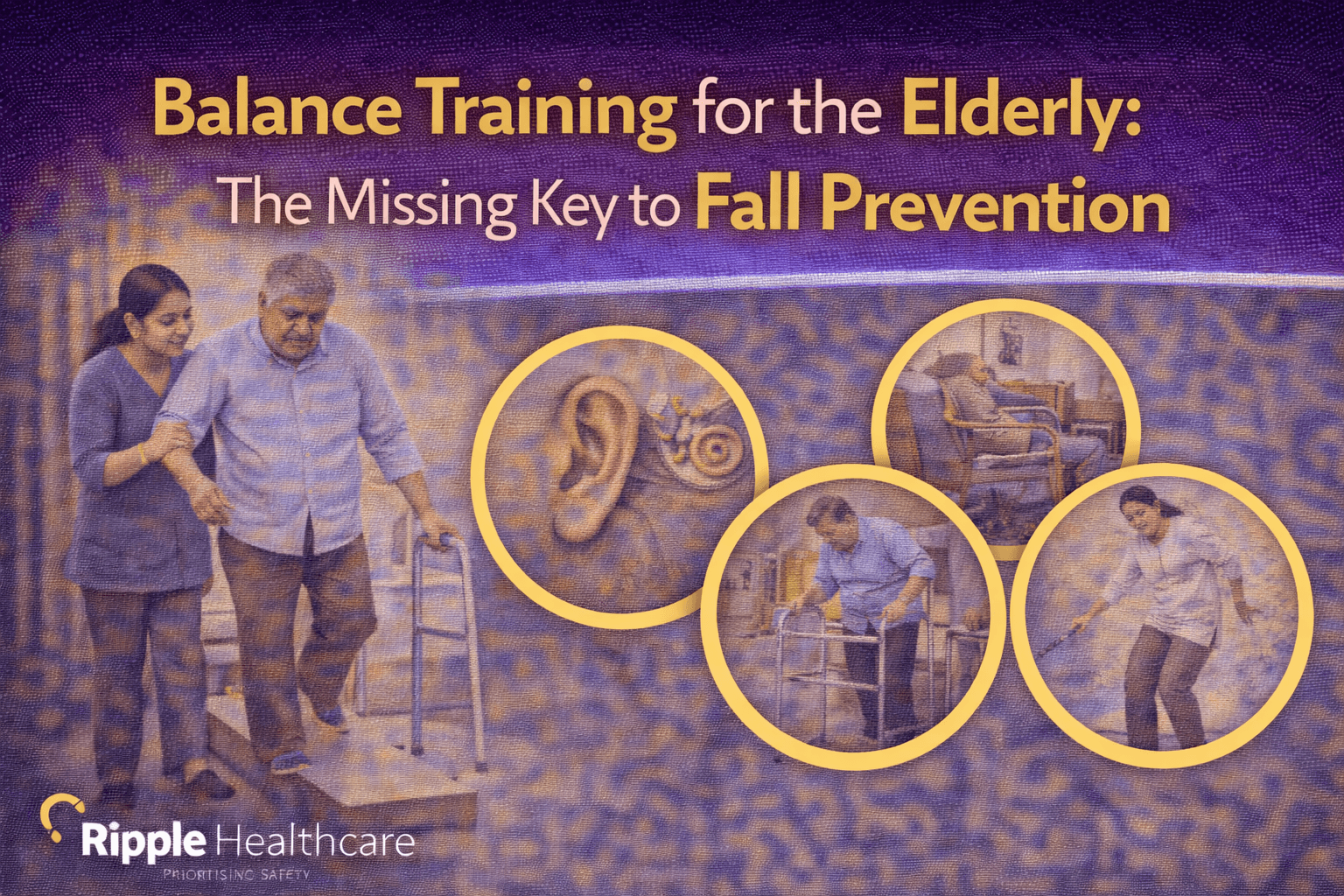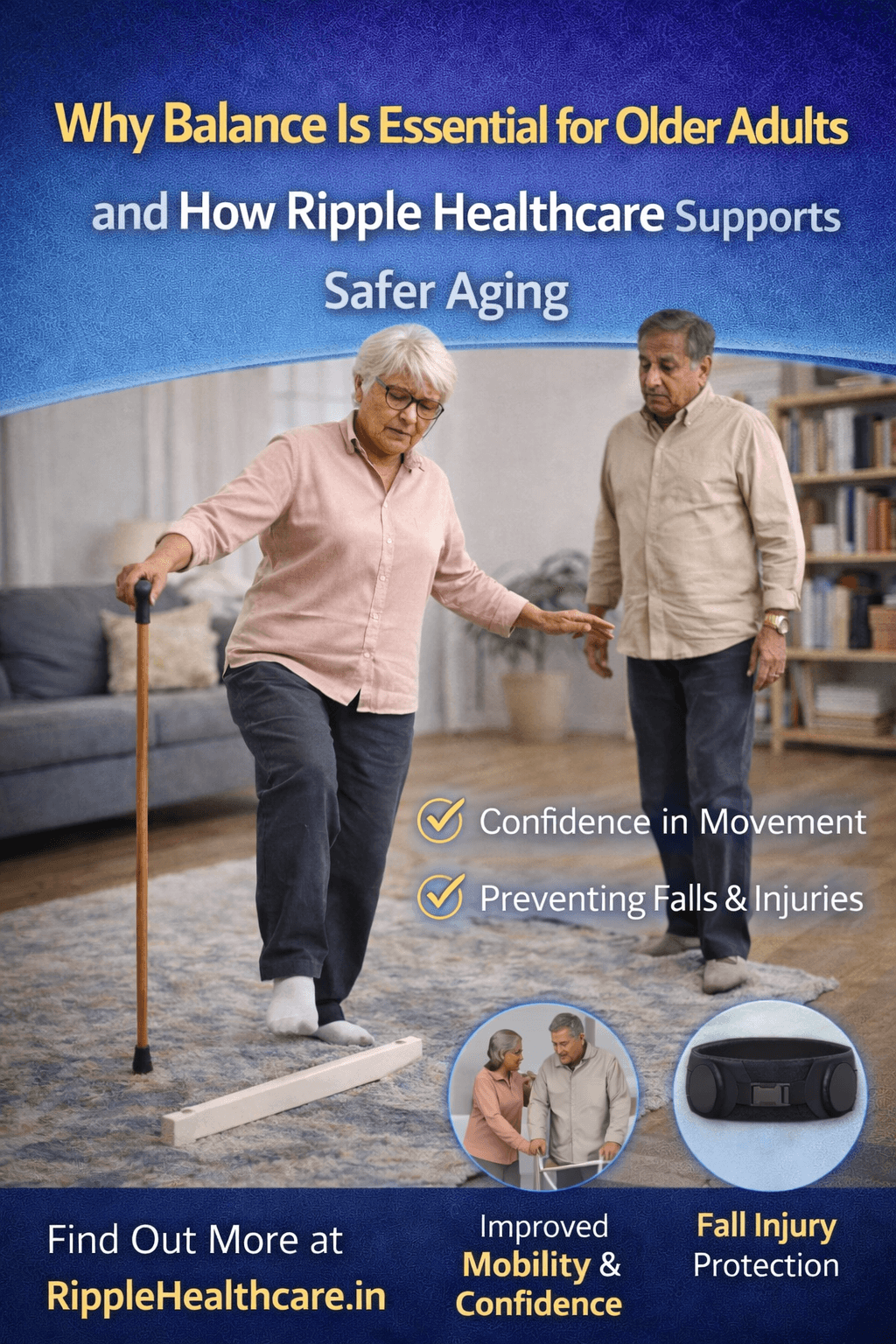



After a hip fracture, most elderly patients focus on surgical recovery — but rebuilding balance is what truly restores independence. This guide helps families and caregivers understand how and when to restart balance training safely after a hip fracture.
Why Balance Training Is the Step Most Families Miss After a Hip Fracture
When an elderly parent or grandparent survives a hip fracture, the family's entire focus — understandably — goes toward surgical recovery, wound healing, pain management, and basic mobility. Weeks pass in hospitals and care facilities. And then, when the person finally comes home, there is a collective exhale of relief. But there is one critical piece that is almost always overlooked: restoring balance. A hip fracture does not just break a bone. It disrupts the body's entire system of stability — the muscles that stabilize the pelvis and hip joint weaken from weeks of inactivity, the nervous system loses some of its fine-tuned response to ground signals, and the person's own confidence in their ability to stand and walk without falling takes a serious hit. Research has consistently shown that elderly individuals who do not address balance specifically after a hip fracture are at significantly higher risk for a second fall — and a second hip fracture. That second injury often has far worse outcomes than the first. Balance training is not about doing difficult exercises. For an elderly person recovering from a hip fracture, it is a gentle, phased process of re-educating the body and the mind to trust movement again. This blog is a practical guide for families and caregivers who want to understand what that journey looks like, when it should begin, what it involves, and how to support a loved one through it safely.
The connection between hip fractures and balance loss
The hip is central to how the body maintains upright posture. When it is fractured and surgically repaired, the surrounding muscles — particularly the glutes, hip flexors, and core stabilizers — weaken rapidly due to bed rest and reduced movement. This weakening directly impairs balance. Without targeted retraining, these muscles remain weak long after the bone itself has healed, leaving the person vulnerable to another fall even months after discharge.
Why families assume rest is the answer
Many families believe that rest, time, and careful avoidance of activity are what will protect their loved one from falling again. This is an understandable instinct, but it works against recovery. Prolonged inactivity causes further muscle loss (a condition called sarcopenia), reduced bone density, and actually increases stiffness and fall risk. Gentle, guided movement — including balance training — needs to begin as early as the treating physiotherapist recommends, not after the family feels "fully ready."
The psychological dimension that gets ignored
Beyond the physical, most elderly people develop a significant fear of falling after a hip fracture — even if they are told the bone has healed well. This fear causes them to move hesitantly, hold their breath during transitions, and rely so heavily on support that their balance muscles never get used. Acknowledging this fear and addressing it as part of rehabilitation is not optional. It is essential to helping the person reclaim their independence.
When Can Balance Training Begin? Understanding the Phases of Recovery
One of the most common questions families ask physiotherapists and doctors is: "When is it safe to start balance exercises?" The answer depends on the type of fracture, the surgery performed, and how the person is healing — but there is a general framework that helps families understand the progression. Balance training after a hip fracture is not a single event. It unfolds in phases, each building on the previous one. Trying to rush ahead can be harmful, but staying too far behind — out of fear — causes its own damage. It is important to understand that every individual heals differently. These phases are general guides, not fixed timelines. Always follow the specific advice of the treating orthopaedic surgeon and physiotherapist before beginning any exercises.
Phase 1 — Acute recovery (first 2–6 weeks post-surgery)
During this phase, the primary goal is safe movement for daily activities — getting in and out of bed, walking short distances with a walker, and managing basic transfers. Balance work in this phase is largely passive: sitting upright without support for short periods, shifting weight gently side to side while seated, and practicing controlled standing transitions with assistance. These small actions begin re-engaging the stabilizing muscles without placing unsafe load on the healing bone.
Phase 2 — Early rehabilitation (weeks 6–12)
Once the surgeon confirms adequate bone healing and the physiotherapist assesses the person's strength and stability, more active balance training begins. This typically includes standing on both feet with reduced support, practicing weight shifts while standing, marching gently in place while holding a support rail, and building endurance in upright posture. Exercises are done in a safe environment — with a non-slip mat, near a stable surface to hold, and with a caregiver or therapist present.
Phase 3 — Progressive balance and confidence building (3–6 months)
This is the phase where real balance gains happen. The elderly person may now be walking independently with a stick or walker and is ready for progressively challenging balance activities. These include single-leg weight shifts (with support), tandem standing (one foot in front of the other), gentle stepping over small objects, and practicing balance while turning the head or performing a simple cognitive task simultaneously. This phase often coincides with the person returning to more normal daily activities at home.
Practical Balance Exercises for Post-Hip Fracture Recovery (Phase by Phase)
Below are specific exercises commonly used in post-hip fracture balance rehabilitation. These should only be attempted after receiving clearance from a doctor or physiotherapist, and always with a caregiver nearby for safety. If the person reports pain, dizziness, or discomfort at any point, stop immediately and consult the treating professional. For each exercise, the starting position and safety setup matter as much as the movement itself. Always ensure the floor surface is non-slip, the person is wearing supportive footwear (not rubber-soled socks or loose slippers), and there is something stable within reach — a kitchen counter, wall-mounted rail, or heavy chair back.
Seated weight shifts (Phase 1 onwards)
Have the person sit in a firm chair with both feet flat on the floor. Ask them to slowly lean their body weight to the right until they feel it shift onto the right hip, hold for two to three seconds, then return to center and repeat on the left. This simple exercise begins reactivating the core and hip stabilizers that balance depends on. It is safe, painless, and can be done multiple times daily. As strength improves, the lean can become slightly more pronounced.
Supported standing balance (Phase 2 onwards)
With the person standing near a countertop or rail, ask them to hold lightly with both hands and simply stand upright for thirty to sixty seconds. The goal is not to be completely still — small natural sways are healthy and encourage the balance system to work. Over time, the person can try holding with one hand only, then progress to very light fingertip contact. This trains the body to rely on internal balance cues rather than the constant grip of the support.
Weight transfer and step practice (Phase 3 onwards)
Standing with both hands available to hold support, have the person slowly shift their weight onto one foot while lifting the opposite heel, holding for five to ten seconds before switching sides. This begins the process of single-leg loading — which is essential for normal walking. As this becomes easier, they can try lifting the whole foot slightly off the ground for a brief moment. Later, small forward and lateral steps can be practiced, which directly prepare the person for safe navigation of their home environment.
How Caregivers Can Support Balance Recovery Without Creating Dependence
This is one of the most delicate aspects of post-fracture recovery, and it is something that families genuinely struggle with. The caregiver's natural instinct is to hold on, to step in, to prevent any possibility of the elderly person losing their balance. This comes from love — and it is also, if not managed thoughtfully, one of the biggest barriers to the person regaining their independence. When a caregiver holds the elderly person too tightly during every movement, the person's balance muscles never have to work. When a caregiver walks beside them hovering in a way that makes the elderly person anxious, it disrupts the calm, focused attention that balance training requires. And when a caregiver inadvertently communicates fear — through gasps, sudden grabs, or verbal warnings delivered too urgently — the elderly person may become too afraid to attempt any movement at all. The caregiver's role in balance rehabilitation is to be present, safe, and encouraging — not to be the person's balance system. Here is how to do that well.
The "ready assist" position
Rather than holding the person's arm constantly, a caregiver can stand close behind and slightly to the side — within arm's reach — with their own hands at waist level, ready to provide support only if needed. This gives the elderly person the psychological security of knowing help is right there, without removing the balance challenge entirely. Physiotherapists sometimes call this the "guarding position" and it is a powerful way to build confidence alongside capability.
Using calm, clear verbal guidance
What a caregiver says during balance exercises matters enormously. Phrases like "You're doing great, take your time" are far more effective than "Be careful, don't fall!" The first builds calm focus; the second triggers anxiety that tightens the body and actually increases the risk of losing balance. Encourage the person to breathe slowly, look forward (not down at their feet), and move at their own pace. Celebrate small wins — standing three seconds longer than yesterday is a genuine achievement worth acknowledging.
Knowing when to step in — and when not to
Caregivers should step in to assist immediately if the person begins to tip beyond what they can self-correct, reports dizziness, or asks for help. They should not step in simply because the person sways slightly, moves more slowly than expected, or holds their expression of concentration and effort. Learning to distinguish between a momentary wobble (normal and healthy during balance training) and a genuine loss of stability (needs assistance) is a skill caregivers develop over time. When in doubt, err on the side of safety — but try not to intervene before it becomes necessary.
Rebuilding Mental Confidence: Addressing the Fear of Falling During Rehabilitation
It would be incomplete to talk about balance training after a hip fracture without talking about fear. Studies on elderly rehabilitation consistently show that fear of falling — clinically known as post-fall syndrome — is one of the most powerful predictors of poor recovery outcomes. An elderly person who is deeply afraid of falling will restrict their movement, avoid activities they are actually physically capable of, and gradually lose the very strength and balance they are trying to rebuild. The fear becomes self-fulfilling. This fear is not irrational. The person has experienced a painful, frightening injury. Their body has been through surgery and a difficult recovery. They have seen the family's anxiety. They may have had a moment of lying on the floor unable to get up — an experience that leaves a lasting mark. Acknowledging all of this with empathy, rather than dismissing the fear with reassurances like "You'll be fine, just try," is the starting point for helping the person move through it. Mental confidence in recovery does not come from thinking about it. It comes from safe, repeated, successful experiences of movement. Every time an elderly person stands up, shifts their weight, and does not fall — and then does it again — they are building not just physical balance but confidence in their own body. The family's role is to create conditions where those experiences can happen safely and regularly.
Structured daily practice builds confidence faster than occasional effort
A person who attempts balance exercises twice a week progresses more slowly — and feels less secure — than one who practices for ten to fifteen minutes every day. Daily practice means the body and brain are continuously reinforcing the neural pathways that support balance. It also gives the elderly person a sense of routine and progress. Families can help by building balance practice into an existing daily anchor — for example, doing a few standing exercises right before or after a meal when the person is already up and moving.
Tracking small wins to shift the narrative
A simple diary or chart — even just a piece of paper on the wall — where the person or caregiver notes each day's exercise and any progress (stood for ten seconds today without holding on; walked to the kitchen without the walker for the first time) can be profoundly motivating. It shifts the mental focus from "what I cannot do yet" to "what I am gaining each day." For elderly individuals who feel demoralized by their recovery pace, visible evidence of progress is genuinely healing.
When to involve a mental health professional
For some elderly individuals, the fear of falling after a hip fracture reaches the level of clinical anxiety or depression — both of which are extremely common in this population and both of which significantly impair recovery. If the person is refusing all balance activity despite being physically cleared, expressing hopelessness about recovery, withdrawing from family interaction, or showing persistent low mood, this is worth raising with their doctor. Brief psychological support or counselling alongside physiotherapy has good evidence for improving outcomes in elderly rehabilitation.
A Steady Path Forward: What Families Should Take Away
A hip fracture is a significant event in an elderly person's life — but it does not have to be the end of their independence or their confidence in their own body. The path from fracture to full, safe mobility runs directly through balance rehabilitation. This is not a step that can be skipped or delayed indefinitely. It is the work that determines whether someone goes on to live fully at home or lives in a state of fear and restriction that diminishes their quality of life every day. The good news is that the brain and body are more adaptable than we often give them credit for. With consistent, safe, and well-supported balance training — started at the right phase of recovery and maintained with patience — elderly individuals can genuinely rebuild their stability to levels that allow them to move through their homes and their lives with renewed confidence. Families and caregivers are not just bystanders in this process. They are active participants whose presence, communication, and support make a profound difference in how well and how quickly recovery progresses. The goal is not perfection. The goal is a person who feels safe in their own body, who can stand up from a chair without fear, who can walk to the kitchen and back without dreading the journey. That goal is achievable — and it begins today, with the next small, safe, supported step.
Start the conversation with the physiotherapist early
Before your loved one comes home from hospital or care facility, speak with the treating physiotherapist about exactly when and how balance training should begin, what exercises are appropriate for their specific surgery and recovery stage, and what safety precautions are needed at home. This conversation prevents the most common mistake in post-fracture recovery: waiting too long to begin.
Prepare the home environment before balance training begins
Remove loose rugs and clutter from walking paths, install a grab bar near the toilet and in the shower if not already present, ensure all rooms the person uses have adequate lighting, and identify a stable surface in each room (counter, rail, or heavy piece of furniture) that can be used as a balance support during exercises. A safe environment is the foundation everything else is built on.
Remember that progress will not be linear — and that is normal
There will be days when the elderly person feels stronger and days when fatigue, pain, or low mood means they do less. This is expected and does not mean recovery has stalled. What matters is the overall trend over weeks and months — and the consistent belief, held by both the person and their family, that each small effort is building toward something real. Ripple Healthcare's tools and resources are here to support families at every stage of that journey.