


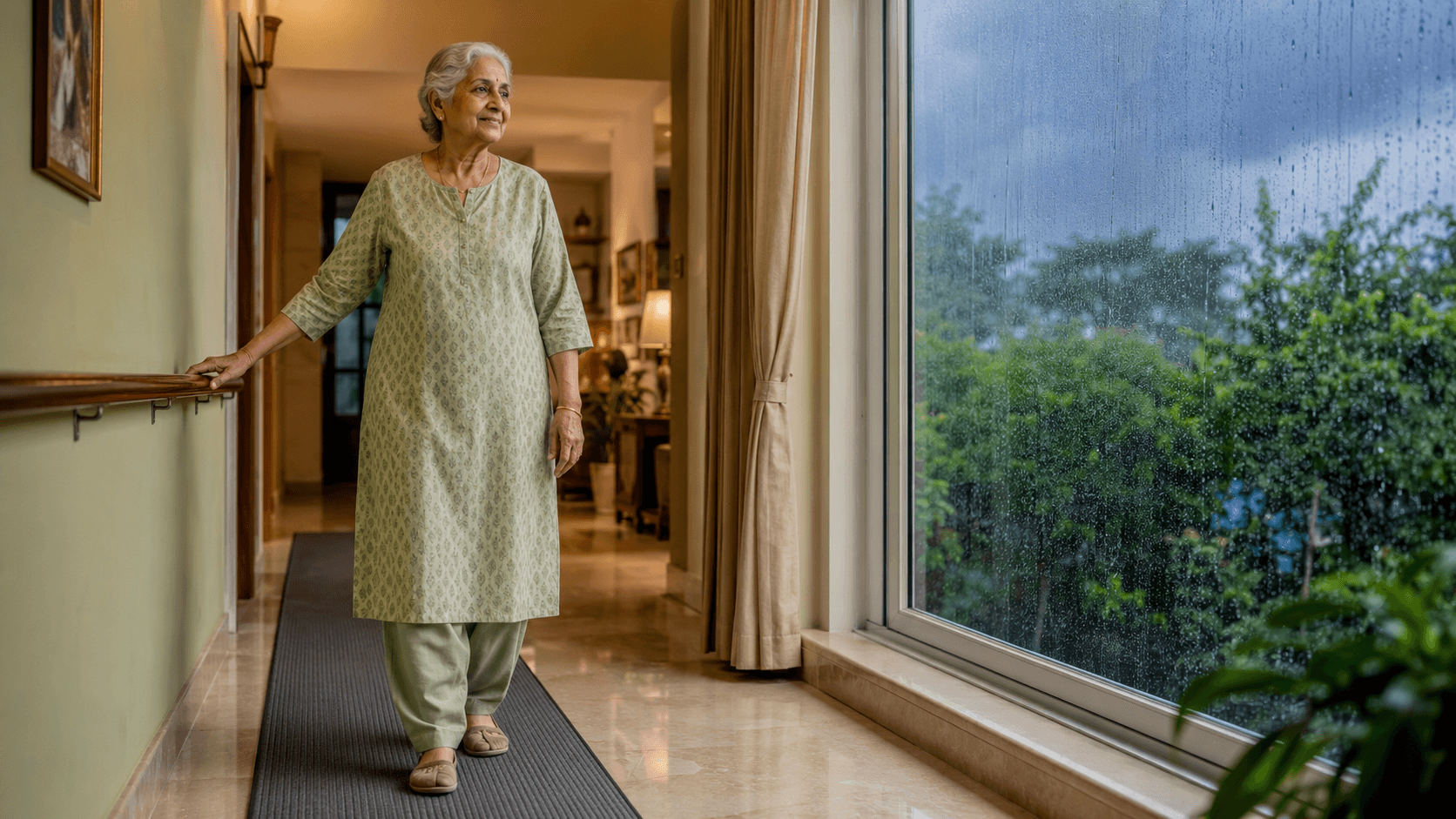
Monsoon raises fall risk for elderly parents at home. Get a room-by-room safety checklist — from entryways to bathrooms — to protect them this season.
Monsoon-Proofing Your Home: A Room-by-Room Fall Prevention Checklist for Elderly Parents
Every June, as the first monsoon clouds gather over India, families quietly brace for something most people never think to prepare for: a season-long spike in household fall risk. Wet floors, slippery thresholds, dim power-cut evenings, and humidity-swollen door mats turn ordinary rooms into hazard zones for elderly parents — and most of this risk is preventable with a single afternoon of planning. For three to four months, the rhythm of an entire household changes. Windows stay shut longer. Floors take longer to dry. Footwear is damp more often than not. For a young, steady adult, these are minor inconveniences. For an elderly parent whose balance, reflexes, and bone density have already declined with age, each of these small shifts adds up to a meaningfully higher chance of a fall — and falls in older adults are rarely "minor." A single fall can mean a fractured hip, weeks of hospitalisation, and a permanent loss of independence. The good news is that most monsoon-related fall risk doesn't come from anything dramatic. It comes from a curled-up doormat, a dim hallway, a missed step on a wet veranda. These are fixable in an afternoon, room by room, without any renovation. This guide is built exactly that way — a practical, room-by-room walkthrough that any family can complete this week, before the rains intensify.
Why Monsoon Months Deserve Special Attention
Fall risk for older adults isn't constant through the year. It rises noticeably during the monsoon, and not for vague reasons — there are specific, identifiable factors at play, each of which is fixable once you know to look for it.
Wet Surfaces Stay Wet Longer
In dry months, a wet patch of floor evaporates in minutes. During monsoon, ambient humidity can keep that same patch slippery for hours. Floors near entry doors, balconies, and bathrooms are particularly affected, because they're exposed to moisture repeatedly throughout the day — every time someone steps in from outside, every time the bathroom is used, every time washing is hung to dry indoors because the terrace is wet.
Lighting Becomes Unreliable
Monsoon storms bring frequent power cuts, often without warning, and often in the evening or at night — exactly when household movement (and the risk of a misstep) is highest. A senior who needs to use the bathroom at 2 a.m. and finds the hallway suddenly dark is in a meaningfully more dangerous situation than the same walk on a well-lit night.
Footwear Changes
During the monsoon, shoes and chappals get left wet near entryways, and people frequently walk indoors barefoot or in socks to avoid tracking water in. Both bare feet and socks have far less grip on wet tile than rubber-soled indoor slippers, making this small, well-intentioned habit a surprisingly common fall trigger.
Joint Stiffness Increases
Many older adults report increased joint pain and stiffness during humid weather — a pattern widely reported anecdotally and increasingly studied in geriatric and rheumatology research. Stiffer joints subtly change gait, slow reaction time, and reduce the ability to "catch" a stumble before it becomes a fall.
Mats and Rugs Misbehave
Coir or cloth doormats absorb water during monsoon and curl at the edges as they dry unevenly — creating a trip hazard exactly where people are stepping most carefully, right at the threshold of the home. None of these require major renovation to fix. They require attention — and a clear room-by-room plan.
Entryway and Veranda: The Highest-Risk Zone in the House
The entryway is where the outside world — and the rain — first enters the home, making it statistically the highest-risk zone during monsoon months. It's also the most overlooked, because families tend to focus fall-prevention efforts on the bathroom and forget that the front door sees just as much wet-floor traffic.
Quick-Dry, Rubber-Backed Mats
Replace absorbent cloth or coir mats with a rubber-backed, quick-dry mat that won't curl at the edges as it dries. These mats are inexpensive, widely available, and solve the single biggest entryway hazard in one purchase.
A Dedicated Drying Routine
Keep a dry towel or mop at hand specifically for the entry, and build a household habit of wiping the floor the moment anyone comes in wet — rather than waiting until someone notices the puddle.
A Second Mat Just Inside the Door
Wet shoes track water further into the home than most people expect. A second mat a few steps inside the entryway catches this residual moisture before it reaches open floor or a hallway.
Marking Uneven Steps
If the veranda or porch has any uneven step or threshold, mark its edge with bright tape so it remains visible even in the low evening light typical of overcast monsoon days.
Bathroom: Where Most Falls Already Happen
The bathroom remains the single most common location for falls among older adults in any season — combining wet floors, hard surfaces, and the physical demands of getting up and down. Monsoon humidity simply raises the baseline risk further.
Non-Slip Mats Inside and Outside
Use non-slip mats both inside and outside the shower or bucket-bathing area — not just one or the other. Many households place a mat only outside the wet area, which leaves the most dangerous zone, the wet floor itself, completely unaddressed.
Secure, Well-Placed Grab Bars
Check that grab bars near the toilet and shower are firmly fixed to the wall. Humidity can loosen wall fittings and adhesive-mounted bars over the course of several months, so a pre-monsoon check is worth doing even if the bars were installed securely last year.
Automatic Nightlights
Keep a nightlight in the bathroom that turns on automatically rather than requiring a switch to be found in the dark. The bathroom is the single most common destination for nighttime walks, and combining darkness with a wet floor is one of the clearest paths to a fall.
A Post-Use Wipe-Down Habit
Wipe down tiles after every use during heavy rain weeks. Soap residue combines with ambient moisture in ways that make floors noticeably more slippery than the same residue would be in dry weather.
Bedroom and Hallway: The Most Dangerous Walk in the House
Most night-time falls happen on the short walk between the bed and the bathroom — a walk that's usually taken half-asleep, without full attention, and often without turning on a main light. Monsoon power cuts make this already-risky walk riskier still.
A Reliable Light Source at the Bedside
Keep a torch or battery-powered lamp on the bedside table for power-cut nights, rather than relying on a phone flashlight that requires unlocking a screen and fumbling for an app in the dark.
A Genuinely Clear Path
Ensure the path from bed to door is completely clear — no slippers left in the walking line, no books or bags on the floor, no charging cables stretched across the route. This is worth re-checking specifically during monsoon, when extra items (umbrellas, wet clothes, drying towels) tend to accumulate in bedrooms.
Marking Thresholds and Steps
If there's a threshold, step-down, or change in flooring level anywhere in the hallway, add contrast-colour tape so it remains visible in dim or emergency lighting.
Motion-Sensor Lighting
A motion-sensor night light for the hallway removes the need to find a switch in the dark entirely — the light simply turns on as someone approaches, which is particularly valuable during a power-cut-prone season when even the main switch may not work.
Kitchen: Small Spills, Bigger Risk in Monsoon
Spills are inevitable in any kitchen, but monsoon humidity means they take longer to evaporate, and floors can feel subtly damp even without an obvious spill — making the kitchen riskier than it appears at a glance.
Immediate Spill Response
Wipe spills immediately, and keep a designated cloth near the stove and sink specifically for this purpose, so cleaning up doesn't require a search for a towel mid-task.
Reorganising for Reach
Store frequently used items between waist and shoulder height so there's no need to use a stool or step to reach them — especially relevant on a day when the floor might be damp and a stool less stable than usual.
Anti-Skid Flooring Solutions
If the kitchen floor is tiled, consider an anti-skid floor treatment or strategically placed rubber-backed mats near the sink and stove, the two zones where water and oil are most likely to land on the floor.
Building a Caregiver Routine, Not Just a One-Time Fix
A single walkthrough fixes the obvious hazards, but monsoon conditions change day to day — a heavier rain spell, a longer power cut, a humid stretch that doesn't let floors dry properly for a week. The most effective families don't treat this as a one-time checklist; they build small daily habits around it: A quick floor check near the entry each time it rains heavily. A standing instruction at home that spills, wherever they happen, get wiped immediately rather than "later." A torch kept charged and in a known location, checked weekly during monsoon. A brief daily check-in call or visit if the elderly parent lives alone, simply to confirm they're moving around safely. These habits cost a few minutes a day and meaningfully reduce risk across the entire season, not just on the day the checklist was completed.
Beyond the Home: Why Detection Still Matters
A thorough home walkthrough meaningfully reduces fall risk — but it can't eliminate it entirely. Balance naturally declines with age, and a moment of stiffness, a missed step, or a brief power cut can still lead to a fall even in a well-prepared home. This is exactly the gap that wearable fall-protection technology is designed to close. The Ripple HipPro Belt uses AI-powered motion sensing to monitor posture and movement up to 100 times per second. If it detects the onset of a fall, it inflates protective cushioning around the hips in real time — specifically guarding against hip fractures, which are often the most life-altering injury an older adult can experience, frequently marking the difference between a full recovery and a permanent loss of independence. For families who can't always be present — especially during a season when slippery floors and power cuts raise the odds of an unwitnessed fall — it adds a layer of protection that home modifications alone can't provide. The accompanying app lets caregivers track wearing time and activity levels, add emergency contacts, and receive fall alerts directly, so protection doesn't depend on someone being in the room when it matters most.
A Simple Way to Start
Rather than tackling every room at once, pick one this weekend. Walk through it the way your parent does — slowly, and paying attention to where their feet actually land, not where you assume the risk is. Most monsoon-related fall risks become obvious the moment you look for them with that mindset. And if you're unsure how much balance decline may already be a factor — something that often goes unnoticed until a fall actually happens — Ripple Healthcare's quick assessment is a useful starting point: Check your balance. Falls are preventable, not inevitable. A safer home, paired with the right safety technology, gives elderly parents the confidence to keep moving through monsoon season — and every season after it.