

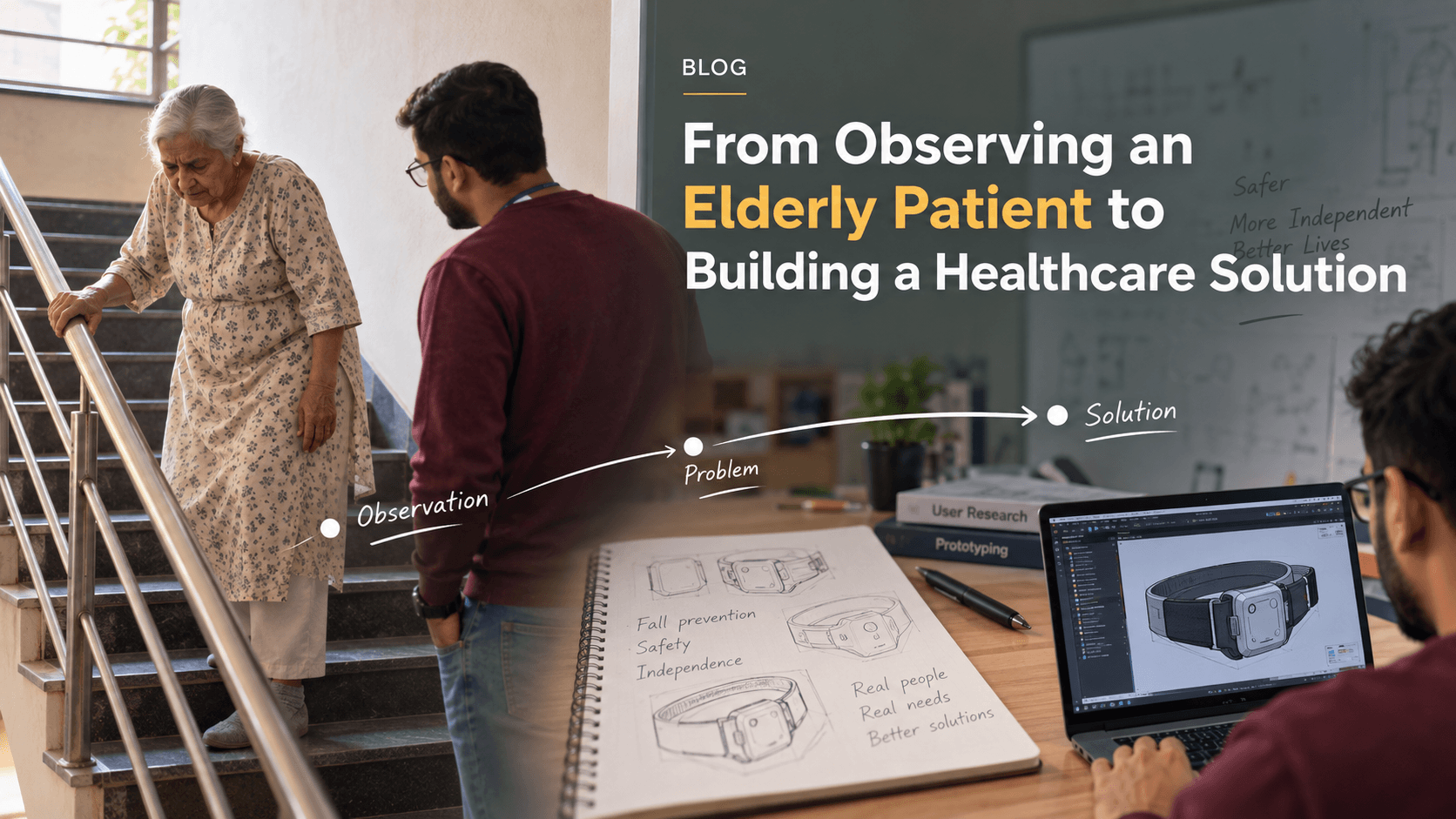
Some healthcare innovations begin in a laboratory. Others begin with a research paper, a new sensor, or an emerging technology. At Ripple Healthcare, one of our most important product journeys began somewhere much simpler: by observing an elderly woman struggling to move. It was a moment that highlighted how a seemingly ordinary situation can reveal a much deeper healthcare problem—and how understanding that problem can become the starting point for developing a meaningful solution.
It Started With an Observation
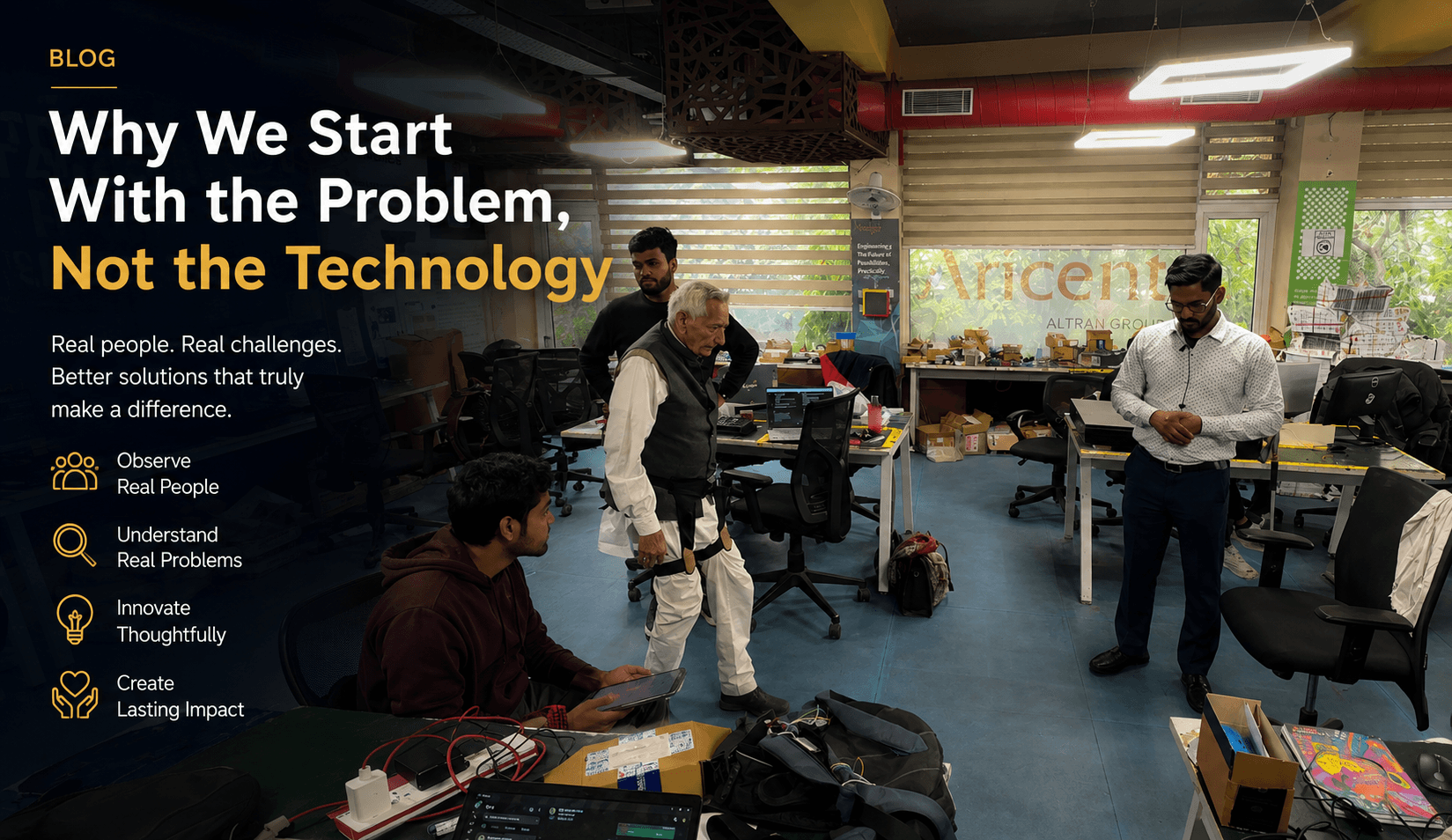
Our founder once observed an 85-year-old woman standing on a staircase, holding onto the railing. She needed to use the restroom, but there was no one around to assist her. She began trying to move down the stairs by herself. Then she stopped. She remained there for approximately 10–15 minutes, unable to move forward. When our founder asked her why she was unable to continue, her response revealed the real issue. She was afraid of falling. This was more than a moment of hesitation. For an older adult, the fear of falling can become a significant barrier to movement and independence. Even when a person wants to move, the perceived risk of injury can make them stop altogether. That observation became the motivation to explore a solution that could help prevent traumatic injuries resulting from falls. For us, this story represents an important principle in healthcare innovation: The right technology often begins with simply paying attention to the right problem.
Looking Beyond the Obvious Problem
At first glance, the problem could have been defined simply as "elderly people fall." But understanding the situation more deeply reveals several interconnected challenges. There is the physical possibility of a fall. There is the possibility of serious injury. There is the fear associated with falling. And there is the potential loss of independence that can follow when an older adult becomes less confident about moving without assistance. This is why we believe problem identification cannot stop at identifying an obvious symptom. We need to understand the person experiencing the problem and the circumstances in which it occurs. What is making movement difficult? What is making the person feel unsafe? What happens if the problem continues? And, most importantly, can a practical solution be developed that makes a meaningful difference?
Understanding the User Before Building
An observation may provide the initial insight, but it is not enough to justify building a healthcare product. At Ripple Healthcare, we conduct user studies and surveys before moving into solution development. These studies help us understand the actual needs of potential users and determine whether an existing solution already addresses the problem. If solutions already exist, we look for the gaps. This is an important part of our process because innovation does not necessarily mean inventing something that has never existed before. Sometimes innovation means understanding why an existing solution does not work well enough for a particular user or environment—and then addressing that gap. The objective is not simply to create another product. It is to create a better answer to a genuine need.
Asking Whether the Problem Is Significant
Once we understand the problem and the user, we also need to understand its broader significance. At Ripple Healthcare, we consider factors such as Total Addressable Market (TAM), Serviceable Available Market (SAM), and Serviceable Obtainable Market (SOM) when evaluating a potential product opportunity. This provides a way to understand the scale of the opportunity and whether there is a meaningful population that could benefit from the solution. But numbers alone do not define a healthcare problem. The human impact remains central. A product may have a large potential market, but if it does not meaningfully improve safety, independence, rehabilitation, or quality of life, then simply having a large market does not make it a successful healthcare solution.
From Observation to Ideation
Once the problem has been studied and the need has been established, the engineering process begins. Our development process follows a structured progression: Problem identification → User study → Ideation → Prototyping → MVP → Real-world testing → Usability studies → Pilot production → Regulatory and clinical validation → Commercialization. The transition from an observation to a product is therefore not immediate. There are many stages between the two. An idea has to become a concept. The concept has to become a prototype. The prototype has to work. Then it has to be tested. And testing often reveals problems that were not visible during the initial design stage. That is not a failure of the process. It is an essential part of the process.
Building Through Iteration
Healthcare products have to work in real environments, not just on a computer or inside a laboratory. This is why we repeatedly test, observe, collect feedback, and improve. A product may technically perform its intended function but still be uncomfortable for the user. A feature may work perfectly during controlled testing but become difficult to use in a real-world situation. These are exactly the kinds of issues that user feedback can reveal. At Ripple Healthcare, patient feedback is particularly valuable because patients interact with the product in ways that engineers may not anticipate. Their daily experience can reveal problems related to comfort, usability, or practical functionality that may otherwise go unnoticed. The next version of the product can then incorporate those lessons.
Bringing Different Perspectives Together
Building a healthcare solution is not an engineering exercise alone. We work under the guidance of doctors and collaborate with clinicians and physiotherapists for their inputs and feedback. Their experience helps guide product development, identify opportunities, and connect the team with the right people and environments for evaluation. This collaboration is important because healthcare problems exist at the intersection of technology and human care. Engineers understand how to build systems. Clinicians understand patient needs and clinical workflows. Patients understand what it means to actually live with the problem. A meaningful healthcare product needs all three perspectives.
From a Single Observation to a Larger Mission
The story of the elderly woman on the stairs is more than the origin of a product idea. It represents the kind of problem-first thinking that shapes Ripple Healthcare. We believe technology should solve real healthcare problems rather than create another layer of complexity. Our broader goal is to use engineering, clinical understanding, and technology to address challenges related to ageing, mobility, rehabilitation, and patient safety. That means starting with people. Observing what they struggle with. Understanding why they struggle. Studying what already exists. Identifying where the gaps are. And only then asking: What can we build?
The Journey Doesn't End With the Product
A healthcare solution is not complete simply because it has been manufactured. At Ripple Healthcare, deployment, clinical adoption, feedback, and continuous improvement are considered part of the product lifecycle. Once a product reaches customers, we continue collecting feedback from patients, clinicians, therapists, caregivers, and other users. This creates a continuous cycle: Observe → Understand → Build → Test → Learn → Improve. The process can begin with one person's experience, but the goal is to create something that can benefit many more.
Why Observation Matters
Healthcare innovation is often associated with advanced technology, artificial intelligence, sensors, and sophisticated engineering. All of these can be powerful tools. But technology is only valuable when it is applied to the right problem. A single observation can sometimes reveal what a specification sheet cannot. An elderly woman standing on a staircase for 10 minutes revealed a problem involving much more than falling. It highlighted fear, safety, mobility, and independence—all within one everyday situation. That is where meaningful healthcare innovation can begin. Not with a technology. Not with an algorithm. Not with a product.
With a person.
At Ripple Healthcare, we believe that when we take the time to understand real people and real challenges, we can build technology that has a real purpose—and ultimately help create safer care, greater independence, and a better quality of life.