

Healthcare innovation should begin with a real human problem, not an impressive piece of technology. How Ripple Healthcare observes, validates and solves the challenges that genuinely affect older adults — starting with the 85-year-old woman who stood frozen on a staircase, afraid to fall.
The Question That Comes First
In healthcare, it is easy to become excited about technology. A new sensor can measure movement. An algorithm can analyze patterns. A wearable device can collect data continuously. A sophisticated piece of engineering can appear to offer an impressive solution to an important challenge. But at Ripple Healthcare, we believe there is a more important question that should come first: what problem are we actually trying to solve? This is where our product development journey begins. We do not start with a technology and then look for a problem where it can be used. We start by observing people, understanding the challenges they experience, and identifying where technology can genuinely make their lives safer, easier, and more independent.
Starting With People, Not Products
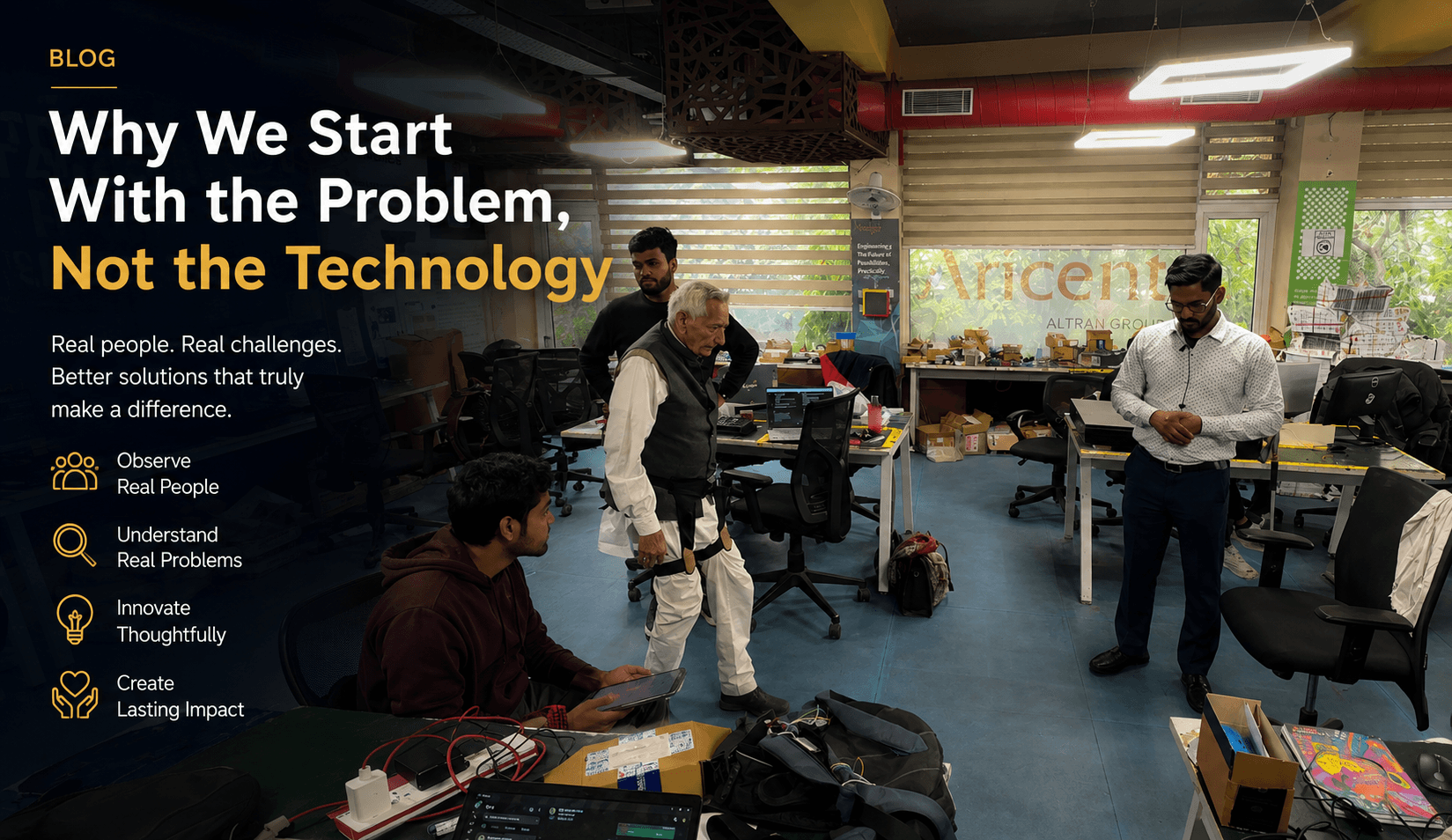
Our approach begins with observation. We look at the challenges faced by older adults and try to understand which problems affect them the most. We consider the severity of the problem, how it affects everyday life, and whether there is an opportunity to develop something that can meaningfully improve the situation. This may sound simple, but it changes the way a product is designed. When the starting point is technology, the focus can easily become centered around what the technology is capable of doing. When the starting point is the person, the focus becomes what the person actually needs. For us, the difference is important. A healthcare product should not exist simply because something can be built. It should exist because there is a meaningful problem that needs to be addressed.
Understanding the Need Before Building
Once we identify a potential problem, we do not immediately begin designing a solution. We first conduct user research and surveys to understand the actual need. This helps us learn more about the experience of the people who would ultimately use or benefit from the product. It also allows us to understand whether solutions already exist in the market. If an existing solution is available, we look at where it may fall short. Rather than simply creating another version of something that already exists, we try to identify the gap where we can contribute something meaningful. This process helps us answer several fundamental questions:
Is this really a problem?
Confirming that the difficulty we observed is genuine and widely experienced, rather than an isolated incident.
How significant is it?
Understanding the severity of the problem and how much it affects everyday life and independence.
What are people currently doing to deal with it?
Learning how older adults and their caregivers manage the challenge today, in the absence of a dedicated solution.
What solutions already exist?
Reviewing the products and approaches already available in the market.
Where are the limitations or gaps?
Identifying where existing solutions fall short, so that we contribute something meaningful rather than duplicating what is already available.
Can we build something that genuinely improves the situation?
Assessing whether our engineering and clinical capabilities can deliver a real improvement for the people affected. Only after understanding these questions do we move toward developing a solution.
A Problem That Started With a Moment of Observation
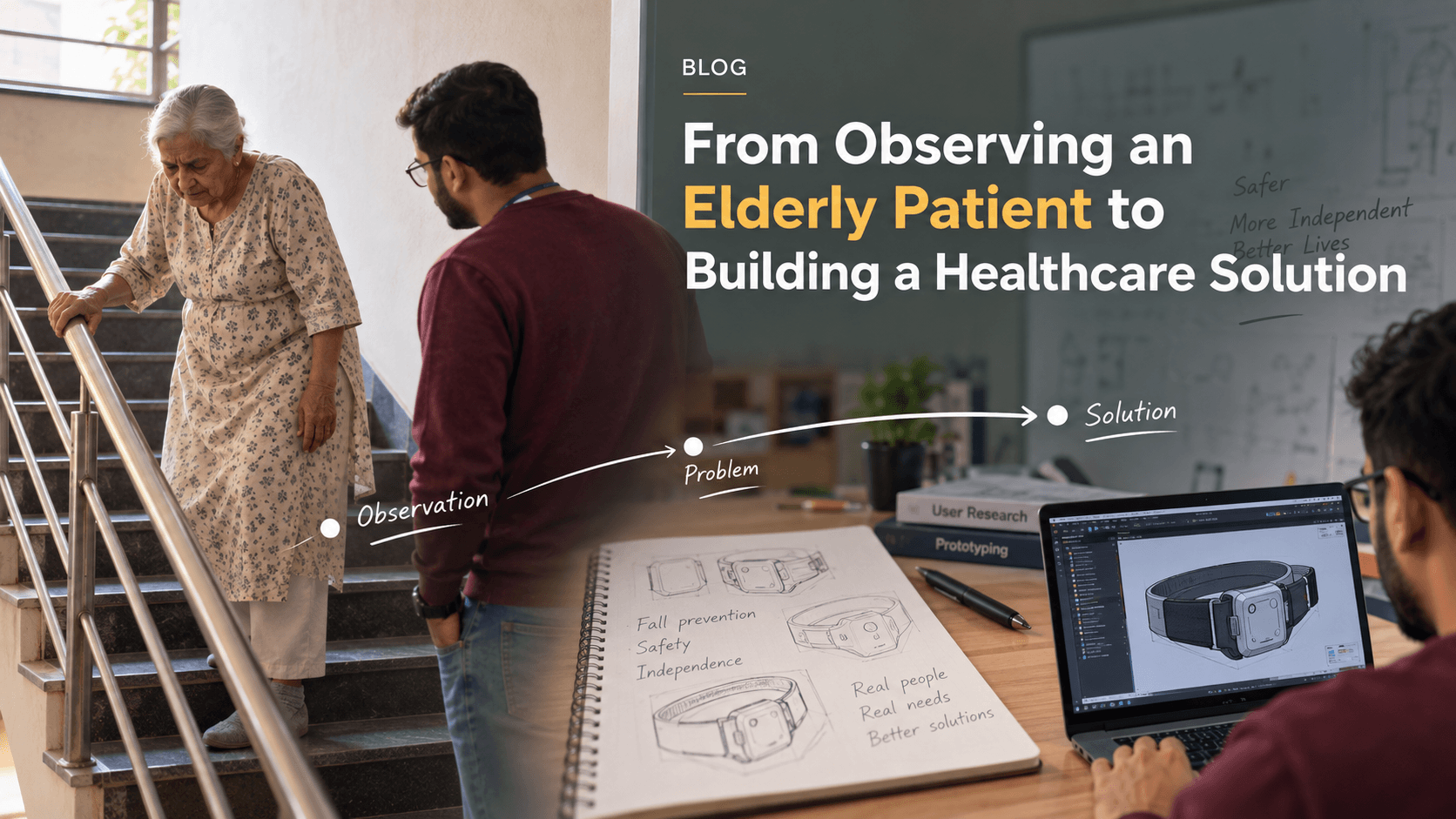
One of the clearest examples of why this approach matters is connected to the origin of one of our products. Our founder once observed an 85-year-old woman standing on a staircase while holding the railing. She needed to use the restroom, but no one was around to assist her. She began attempting to move down the stairs on her own. Then she stopped. She remained frozen on the stairs for approximately 10-15 minutes. When our founder asked her why she could not move forward, her answer was simple: she was afraid of falling. That moment highlighted something deeper than the physical risk of a fall. The problem was not simply that an elderly person could fall. The fear of falling itself had become a barrier to movement and independence. That observation became the motivation to develop a solution focused on preventing traumatic hip injuries from falls. This is the kind of starting point we value at Ripple Healthcare: not a technology looking for an application, but a real human problem creating a reason to develop technology.
Looking at the Bigger Picture
Understanding a problem also means understanding whether it is significant enough to address. As part of our process, we consider the potential market through parameters such as TAM, SAM, and SOM. This helps us understand the broader scale of the opportunity and whether the problem represents a meaningful need. However, market size alone does not define whether a healthcare problem is worth solving. Healthcare technology ultimately affects people. That means we have to consider the practical impact of the problem, the people experiencing it, the healthcare professionals involved, and whether a potential solution can fit into the real environment in which care is delivered.
From Problem to Solution
Once the problem and user need are understood, the development process begins. We follow a conventional product-development approach: problem identification, user study, ideation, prototyping, and iterative development until we reach the MVP stage. From there, we test the product in real scenarios, conduct usability studies, move toward pilot production, and complete the necessary regulatory and clinical validation before commercialization. This process is intentionally iterative. The first idea is not necessarily the final answer. A prototype may reveal an engineering limitation. A usability study may reveal that something is uncomfortable. A real-world test may show that a particular feature does not work as expected. Each of these findings is valuable because they take us closer to a solution that works for the person who actually needs it.
Technology Comes After Understanding
This is why we say that we start with the problem, not the technology. Technology is incredibly powerful, but technology by itself is not the objective. For example, sensors can collect movement data, algorithms can analyze patterns, and connected systems can generate reports and alerts. But the important question is what that information enables us to understand or improve. At Ripple Healthcare, our products use technologies such as IMU sensors, embedded systems, connectivity, algorithms, and data analysis for specific healthcare purposes. HIP PRO+, STRIDE, and BPRO are built around different challenges related to safety, mobility, rehabilitation, and functional assessment. The technology is therefore a means to an end. The end goal is better care.
Building Technology That Has a Purpose
Our philosophy is straightforward: technology should solve real healthcare problems rather than create another layer of complexity. We believe good healthcare technology should be clinically meaningful, evidence-driven, user-centered, practical, reliable, accessible, scalable, and human-focused. It should support healthcare professionals rather than attempt to replace the human element of care. This philosophy influences the decisions we make throughout development. We ask whether the product solves a genuine problem. We ask whether patients can use it comfortably. We ask whether clinicians can understand and use the information it provides. We ask whether it can work reliably outside a controlled laboratory environment. Most importantly, we ask whether it can create a meaningful difference in someone's life.
The Ripple Healthcare Approach
We believe meaningful healthcare innovation starts with empathy and observation. It starts by seeing the person behind the problem. It continues through research, user feedback, engineering, testing, clinical validation, and continuous improvement. And it ultimately succeeds when the technology becomes useful enough to fit naturally into healthcare and valuable enough to improve patient outcomes. For us, innovation is therefore not about building the most complicated technology possible. It is about identifying the right problem, understanding it deeply, and then building the right technology to solve it. Because when healthcare technology begins with the problem, technology becomes more than innovation — it becomes a tool for better care, greater independence, and a better quality of life.